Boddle: Math & Reading Game
- 4.4
- Rating
- 500.00K
- Installs
- Free
- Price

 Analysis by App-foxy
I found Boddle most interesting as a way to make short learning sessions feel more like play than homework. It is an educational game from Boddle that brings math, reading, and science practice into an interactive setting for children. After spending time with it, my impression is that its biggest strength is motivation: it gives a child a reason to keep going when a worksheet would probably be ignored.
That does not make it a complete replacement for teaching, books, or carefully chosen practice materials. I see it more as a bridge between structured learning and the kind of screen time children already enjoy. The free entry point makes it easy to try, while the optional purchases mean parents should still pay attention to how the app is used and what value they actually need from it.
How Boddle turns practice into a game
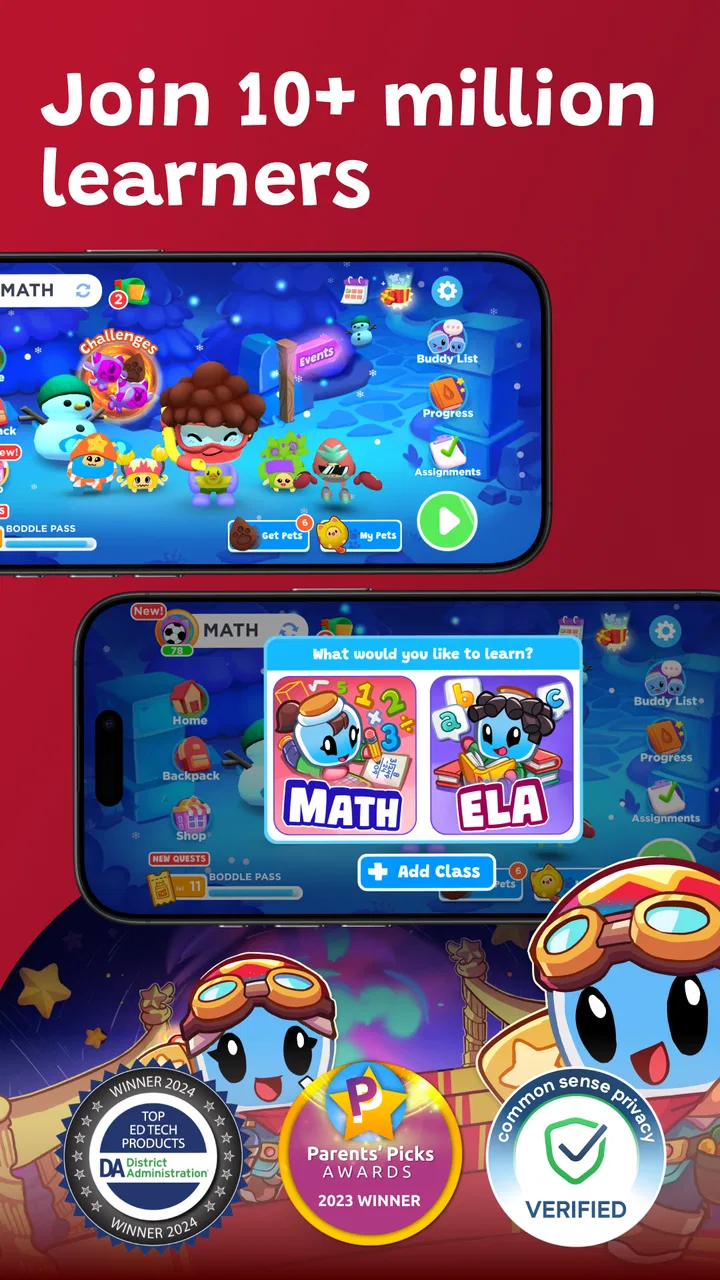
The central idea is simple but useful. Instead of presenting every exercise as a plain question-and-answer task, Boddle places learning inside a game environment. Children can move through activities while working on school subjects, which changes the emotional feel of practice. A child who resists “doing math” may be more willing to complete a few questions if the activity feels connected to a game world.
You May Also Like

 Blood Strike: 2.5 Anniversary
Blood Strike’s Loadouts Turn Every Drop Into a Tactical Gamble
A close look at Blood Strike’s custom loadouts: how fast access to signature weapons reshapes its battle royale rhythm, rewards preparation, and narrows the gap between fights.

 Pandora - Music & Podcasts
Pandora’s Music Is Easy to Start, but Harder to Recover
Pandora’s strength is its low-effort path from a seed to a station. Its weak spot is how much confidence it asks you to place in connection, setup, and quiet recovery.

 8 Ball Pool
 Is Built on Rivalries, Rematches, and Routine
A close look at the rivalries, rematches, shared routines, and unanswered safety questions that turn a quick pool match into a persistent mobile community.

 Samsung Music
’s Quiet Strength Is Playing What You Already Own
Its reach comes less from spectacle than from dependable access to a personal library. That simplicity is both the app’s strongest retention engine and its ceiling.

 AccuWeather: Weather Radar
AccuWeather Review: A Quick, Clear Forecast for Everyday Decisions
For everyday plans, the best forecast is the one you can understand quickly. AccuWeather makes rain timing, radar, and local conditions easy to act on, with a few trade-offs.

 Hill Climb Racing
Why Hill Climb Racing Still Turns Crashes Into One More Run
A tiny car, a bumpy hill and one more upgrade: Hill Climb Racing keeps resurfacing because its simple chaos makes every near-miss feel personal.
More From Our News Desk
View All News


In my experience, that distinction matters most during short sessions. This is not the kind of app I would use as a substitute for a full lesson. I would use it when a child needs extra repetition, a gentle warm-up before homework, or something productive to do during a spare part of the afternoon. The game layer can make starting easier, which is often the hardest part.
The subject range also gives it a broader role than a narrowly focused arithmetic game. Math is likely to be the most obvious use, but reading and science practice make the app more suitable for families who want one learning destination rather than several separate downloads. That variety can help prevent practice from becoming monotonous, although children will still have individual subjects they prefer.
The experience is aimed at children and carries an Everyone content rating. That makes the intended audience clear, but an age label should not be mistaken for a guarantee that every child will use the app independently. Younger learners may need help understanding instructions, choosing an activity, or staying focused on the learning rather than the game presentation.
What a normal session feels like
A realistic use case would be a child returning from school with a small amount of energy left. Rather than asking for a long study period, a parent could suggest one brief Boddle session before dinner. The child gets a manageable opportunity to practise, and the parent can observe whether the game encourages genuine effort or simply becomes another distraction.
I especially like this approach for children who need repetition but dislike visible drills. Repeating similar skills is important for confidence, yet repeated questions can feel dull when presented in a traditional format. A game can soften that resistance. The important detail is to keep the session purposeful: a short, clear goal works better than leaving the child to wander around indefinitely.
Another practical use is a transition activity. A child might use it after finishing schoolwork, during a quiet weekend period, or while waiting for an appointment. I would not hand it over automatically whenever a child asks for a game, because the educational value depends on active participation. It works best when the adult frames it as practice with a playful presentation, not as unlimited entertainment.
Cost, free access, and optional spending
Boddle is free to download and use at its basic entry point, which is important when deciding whether it deserves a place in a family’s routine. There is no need to commit money before seeing whether a child actually enjoys the format or benefits from it. That makes trying the game relatively straightforward for parents who are comparing several educational options.
It also includes optional in-app purchases priced from $0.99 to $69.99 per item. I would treat that range as a reason to make a decision before spending, rather than assuming every purchase is necessary. Free access is useful for testing the learning style; paid value depends on what an individual child needs and whether the extra content or options lead to more consistent practice.
The most sensible approach is to begin with the free experience and watch behavior over several sessions. Does the child return willingly? Are answers being considered, or is the child tapping quickly to get back to the game elements? Does the app support a skill the child is currently working on? If the answer to those questions is mostly yes, a paid option may be worth examining. If not, spending more is unlikely to solve the underlying problem.
I also appreciate that the purchase decision can be separated from the educational decision. A parent can first decide whether the format is appropriate, then consider whether paying adds enough value. That is better than judging the game by its most expensive option or assuming that free access must be too limited to matter. The right choice will vary by child, subject, and how often the app is used.
Where the learning value is strongest
The strongest value comes from motivation and repetition. Boddle is well suited to a child who understands a skill but needs more practice to make it feel comfortable. Game presentation can lower the barrier to beginning, while the subject mix gives families room to vary the routine. That is particularly helpful when a child loses interest quickly with single-purpose drill apps.
It can also support a parent who wants a low-pressure way to identify engagement. If a child consistently chooses one subject and avoids another, that behavior can start a useful conversation. The app does not replace proper assessment, but it may reveal where the child feels confident or where practice feels frustrating. I would use those observations to guide support, not to label the child’s ability.
There is value in having math, reading, and science together because real learning rarely stays inside one subject. A child may be more receptive to reading activities after completing a game-based math task, or may appreciate a change of subject before attention fades. The variety is not automatically effective, though. Parents should still connect the activity to the child’s actual needs instead of treating every available exercise as equally useful.
The best result comes when Boddle is used as a short practice tool with a clear purpose, not as a digital babysitter. That distinction affects both learning and value. A focused session can reinforce a lesson; a long, unsupervised session may produce plenty of screen time without much understanding.
Useful habits that make the app work better
My first practical tip is to set the goal before opening the game. “Practise a few reading activities” is more useful than simply saying “play Boddle.” A specific intention helps the child understand why the app is being used and gives the parent something concrete to discuss afterward. It also reduces the chance that the game presentation becomes the only memorable part.
Second, I would avoid using it immediately as a reward for every completed task. If the app is always framed as a prize, the learning subjects may seem like an obstacle between the child and the game. It can be healthier to present it as one available study option, especially when the child is choosing between reviewing a skill and doing something less productive.
Third, I would watch for speed. Children who are excited by game-like activities may rush through questions, particularly when they are more interested in progression than accuracy. Sitting nearby for the first few sessions can show whether the format encourages thought. If rushing becomes a pattern, shorter sessions and occasional discussion may be more effective than adding more time.
A fourth useful habit is to rotate subjects intentionally. If a child always chooses the easiest area, the app may feel successful while leaving the difficult skill untouched. A parent can alternate a comfortable subject with one that needs attention. This keeps the experience positive without allowing the game to become a way of avoiding the work that matters most.
Tradeoffs compared with ordinary alternatives
Compared with paper worksheets, Boddle is more engaging for children who respond to visual interaction and game-like goals. A worksheet is easier to print, annotate, and review at a glance, while an app can make practice feel less intimidating. The tradeoff is that paper gives an adult a clearer view of the child’s working process. With a game, a correct answer may not reveal whether the child understood the method or guessed.
Compared with a standard educational video, Boddle offers a more active form of practice. Watching an explanation can be useful when a child is learning a new idea, but passive viewing does not always build recall. The game format asks the child to participate. On the other hand, it may not provide the same depth of explanation as a teacher or a carefully made lesson, so I would not rely on it when a child is completely confused by a topic.
Compared with a dedicated math app, Boddle’s subject variety is an advantage for families that want a broader routine. A specialized tool may be better when the goal is intensive work on one narrow skill or when a teacher has recommended a particular method. Boddle feels more appropriate for general reinforcement and motivation than for highly targeted intervention.
Compared with reading a physical book, its reading practice serves a different purpose. A game can encourage exercises and make practice approachable, but it should not replace time spent reading complete stories, discussing ideas, or building patience with longer text. I would pair the app with books rather than choosing one over the other.
Limitations parents should consider
The game structure will not appeal to every child. Some children enjoy direct instruction and may find animated rewards or interactive presentation distracting. Others may prefer physical materials because they can see the entire task at once. If a child becomes more interested in collecting or progressing than understanding, the game layer is working against the learning goal.
There is also a risk of confusing engagement with mastery. A child can enjoy an activity and still need more explanation, slower practice, or a different example. I would pay attention to whether skills transfer outside the app. Can the child solve a similar problem on paper? Can they explain a science idea in their own words? Can they use a new reading skill in a book? Those checks matter more than enthusiasm alone.
The purchase range creates another small point of friction. Free access lowers the barrier to entry, but optional items can make it harder for a family to know when it has reached a sensible stopping point. I would decide on a spending boundary in advance and judge any purchase by repeated usefulness, not by the promise of making the experience feel more complete.
Parents should also be realistic about supervision. The Everyone rating is reassuring for general suitability, but it does not mean every child will understand the educational purpose without guidance. A younger child may need an adult to help with reading instructions, while an older child may need reminders to slow down and think carefully.
Who is most likely to benefit
I would recommend Boddle first to families with children who enjoy games but resist conventional practice. It is also a good candidate for parents who want one app covering several school subjects instead of collecting separate tools for math, reading, and science. The free starting point makes it practical for testing that fit before considering any optional spending.
It may also suit a child who needs frequent, low-pressure repetition. A few focused sessions can be easier to maintain than a large block of homework, especially when attention is limited. The app’s value is highest when the child can work independently for at least part of the time but still benefits from an adult checking the broader learning picture.
I would be more cautious for children who need intensive remediation, detailed teacher feedback, or a carefully sequenced curriculum built around a specific difficulty. In those cases, a specialist, teacher-led resource, or dedicated subject program may be a better primary choice. Boddle can still provide practice, but I would not expect a general game to address every learning need.
I would also skip it if the child strongly dislikes learning through games or if the household is already struggling to manage screen time. Adding another interactive app will not improve a routine that lacks boundaries. A book, printed activity, or direct conversation may be more effective for that family, even if it looks less exciting.
Technical details and everyday value
The game was released on November 14, 2021, and its current version is 1.30.1. It requires Android 9 or later, so compatibility is worth checking before planning around it. Those details do not determine educational quality, but they matter when a child uses an older device or when a family wants to avoid installing an app that the available phone or tablet cannot run comfortably.
Boddle has built a visible user base, with over 500 thousand installs, an average rating of 4.3 from around 2.6 thousand ratings, and roughly 1 thousand written reviews. I see that as a useful sign that the concept has attracted sustained interest, but not as proof that it will suit every learner. Ratings can indicate general satisfaction; they cannot replace watching how a particular child responds.
The developer is Boddle, and the game sits clearly in the educational category rather than presenting itself as a general entertainment title. That positioning matches how I would use it: as a learning aid with a playful surface. The distinction is important because a child may call it a game, while a parent should judge it by whether it supports a real learning routine.
My recommendation after weighing the cost and tradeoffs
My overall view is positive, with sensible limits. Boddle offers a free way to test game-based practice across math, reading, and science, and that is a meaningful advantage for families deciding whether interactive learning works for their child. The optional purchases deserve deliberate consideration, but they do not remove the value of being able to start without paying.
I would try it with a clear routine: choose one subject, set a short goal, stay nearby at first, and check whether the child is thinking rather than rushing. After several sessions, I would compare the child’s performance in ordinary homework or conversation. If the app helps the child approach practice more willingly and retain the skill, it has earned a place in the routine.
I would skip paid extras when the free experience is not producing that benefit, and I would choose a more specialized resource when the child needs deep instruction or targeted support. For the right learner, though, this game makes an everyday problem easier: getting a child to practise without turning every session into an argument. That is not the whole of education, but it is a practical and worthwhile role.
FAQs for Boddle: Math & Reading Game
01What is Boddle, and how does it work?
Boddle is an educational app designed for children that gamifies learning, primarily focusing on math skills. It uses engaging, interactive 3D visuals and personalized learning paths to adapt to each child's unique learning pace. The app rewards progress with virtual items, making the learning process both fun and effective.
02Is Boddle suitable for all age groups?
Boddle is specifically designed for children in elementary school, typically ages 5 to 11. The app is tailored to align with educational standards for these age groups, offering age-appropriate math problems and challenges. Parents and educators can adjust settings to better fit the child's educational needs.
03Does Boddle require an internet connection to function?
Yes, Boddle requires an internet connection to access its full range of features. While some basic functionalities might be available offline, most interactive elements, updates, and progress tracking require connectivity. This ensures that the app can personalize learning experiences and synchronize data across devices.
04Are there any in-app purchases or advertisements in Boddle?
Boddle offers a free version with basic features, but it also includes in-app purchases for additional content and customization options. While the app aims to be child-friendly, parents should monitor purchases to avoid unexpected charges. Boddle is ad-free, ensuring an uninterrupted learning experience for children.
05How does Boddle ensure the safety and privacy of its users?
Boddle prioritizes user safety by adhering to strict privacy regulations like COPPA. The app requires minimal personal information and secures data transmission. Parents can manage privacy settings to control the information shared, ensuring a safe environment for children to learn and play.
Pros
- Engaging educational content for kids.
- Adaptive learning tailored to skill level.
- Colorful
- kid-friendly interface.
- Rewards system motivates continued learning.
- Parental controls for monitoring progress.
Cons
- Limited content for older children.
- Requires constant internet connection.
- Some features behind a paywall.
- Can be too repetitive over time.
- Occasional app crashes disrupt experience.

Boddle: Math & Reading Game
Gallery